The Evidence Is Fake. And the Judge Can't Tell.
India's courts are running on evidence law written for a world without artificial intelligence. Deepfake technology has escaped the lab, entered public life, and spawned its first legal battles. The next frontier is the courtroom itself - and we are catastrophically unprepared.
The Scene in Room 7
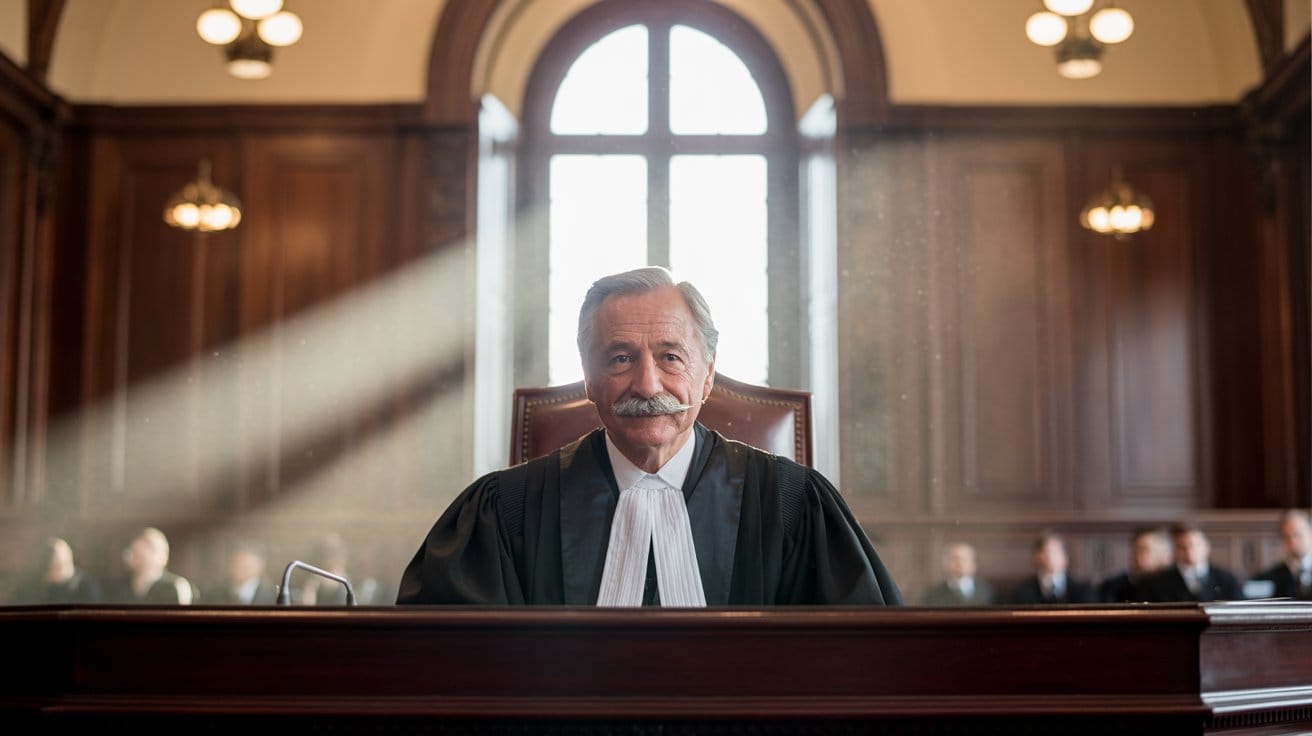
Picture a district court in Rohini, Delhi. A case of assault. The prosecution submits a USB drive containing a 47-second CCTV clip. The footage shows the defendant, clearly identifiable, attacking the victim near a market. The video has timestamps. The resolution is sharp. The lighting is consistent. The metadata on the file traces back to the security company.
The judge reviews it. The defence lawyer reviews it. Neither has the tools, the training, or the budget to do anything other than look at it. The clip looks real because it looks real - and for two hundred years, evidence law has operated on the assumption that looking real and being real are the same thing.
They are no longer the same thing.
The video is AI-generated. The defendant was home that evening. And a legal system that processes over 50 million pending cases - mostly in district courts with no forensic protocols, no dedicated AI detection capability, and no legal framework requiring verification - is about to be tested in ways it has never been tested before.
This isn't a hypothetical designed to alarm you. It's a near-certainty, grounded in where the technology is today and where India's legal infrastructure is not.
The Technology Has Crossed a Threshold
Generation Is Now Trivial
In 2020, creating a convincing deepfake video required a GPU cluster, thousands of source images, weeks of training time, and someone who understood machine learning. In 2026, it requires a smartphone, a free app, three minutes, and a publicly available photograph.
The tools are not fringe. They are mainstream. Applications built on open-source models like Stable Diffusion, Flux, and various face-swapping frameworks are available on GitHub, Discord servers, and Telegram channels. Some charge ₹500 a month. Many are free. The learning curve collapsed years ago.
Video deepfakes are now photorealistic under normal viewing conditions. Audio cloning - once requiring hours of source material - now works from three to five seconds of target voice. Give a model a short voice note, a wedding video clip, a YouTube interview, and it will generate unlimited audio in that voice saying anything you write. The synthetic output is indistinguishable to the human ear approximately 85% of the time in controlled studies. In a courtroom, where the judge hears a clip once through laptop speakers, that number is almost certainly higher.
Synthetic documents are the latest frontier: AI-generated PDFs, WhatsApp conversation screenshots, bank statements, property agreements. These aren't blurry Photoshop jobs. They are pixel-perfect recreations generated by models trained on millions of real documents. The metadata can be seeded to appear legitimate. The fonts, layouts, and signatures are indistinguishable from originals.
The Generator-Detector Gap Is Widening
Here is the structural problem that no regulation can easily fix: generative models improve faster than detection models. Every time a detection tool learns to identify a particular deepfake artifact - unnatural eye blinking, inconsistent lighting, spectral anomalies - the next generation of generators is trained to eliminate exactly those tells. It's an adversarial arms race, and the offense has structural advantages. Generators only need to fool a human once. Detection tools need to catch every fake, every time.
Commercial detection tools - Hive Modulate, Microsoft's Video Authenticator, various academic models - have accuracy rates that range from 65% to 90% depending on test conditions. But those conditions rarely resemble a real courtroom scenario: compressed video, re-encoded footage, variable quality, regional language audio. Lab performance does not survive contact with reality.
The barrier to entry is effectively zero. Any person with a grudge, a pending litigation, and a basic internet connection can now fabricate evidence with the production quality of a professional studio. We have democratised deception.
India-Specific Cases Already in Play
India has already seen its first wave of deepfake-related legal battles. The pattern so far is consistent: the deepfakes existed outside the courtroom - as defamation, harassment, or fraud - and the courts responded after the fact. What hasn't happened yet, at documented scale, is fake content being submitted as evidence inside a court proceeding. That is the next stage.
The Cases That Got Here First
In late 2023, a morphed video of actor Rashmika Mandanna went massively viral - her face transplanted onto another woman's body in an intimate video. The incident triggered arrests under Sections 66D and 66E of the IT Act 2000, dealing with cheating by personation and violation of privacy using electronic means. The case catalysed a national conversation, and the Ministry of Electronics and Information Technology issued its first direct advisory to social media platforms to remove deepfake content.
Shortly after, the Delhi High Court granted an interim injunction in Anil Kapoor v. Simply Life India & Ors [CS (Comm) 652/2023] - a landmark ruling that became India's first formal judicial engagement with personality rights in the context of AI. The court recognised that Anil Kapoor's voice, likeness, mannerisms, and even associated phrases like "jhakaas" were protected from unauthorised AI replication. The case carved out new legal territory: AI-generated impersonation of a living person's identity is actionable, even in the absence of a specific AI law.
The Amitabh Bachchan case in 2024 extended this reasoning further. The Delhi High Court issued a broad injunction protecting Bachchan's voice, image, and character from AI-driven exploitation - covering not just face-swaps but synthetic voice cloning. The ruling established that generating synthetic media of a real person without consent is not merely an IP violation but a distinct legal harm.
Later that year, financial educator Ankur Warikoo secured a court order in Ankur Warikoo & Anr v. John Doe & Ors (Delhi HC, 2024) after his deepfaked image and cloned voice were used in fraudulent stock trading advertisements. The court issued a John Doe order - targeting unknown defendants - and directed Meta to take down the content within 36 hours. Deepfake fraud was being used to deceive ordinary investors at scale, and the platforms, not law enforcement, were the primary enforcement mechanism.
The International Precedent That Should Terrify Indian Litigants
In September 2025, a California court in Mendones v. Cushman & Wakefield issued a terminating sanction - effectively deciding the case against the offending party - after deepfake videos were found to have been submitted as evidence. This is the first documented instance of a court making a definitive ruling based on the discovery of fabricated synthetic media in the evidentiary record.
The case matters because it illustrates the end state: a court that wasn't actively looking for deepfakes, with evidence submitted under standard certification procedures, nearly decided an outcome based on manufactured reality. The fraud was caught. Next time, it might not be.
The Cliff Edge
Look at all six of these cases. Every Indian one involved deepfakes existing externally to a court record. None involved synthetic media tendered as evidence in a hearing. That line has not yet been crossed in India at documented scale.
It will be. The question is whether we have a system capable of responding when it does.
India's Evidence Law - Built for Another Era
A New Code With an Old Architecture
The Bharatiya Sakshya Adhiniyam 2023 (BSA) replaced the Indian Evidence Act of 1872 and came into force in July 2024. It was meant to modernise India's evidentiary framework. For electronic records, it largely reproduced - with modest revisions - the structure that preceded it.
Section 63 of the BSA governs the admissibility of electronic records. It requires a certificate establishing the identity and integrity of the electronic process involved. The Supreme Court's ruling in Arjun Panditrao Khotkar v. Kailash Kushanrao Gorantyal [2020] made this certificate mandatory - without it, electronic records simply do not come in.
The Pune Bar Association Ruling: A Watershed Shift
In a significant recent development, the Supreme Court of India in Pune Bar Association v. Union of India has moved the goalposts from procedural certification to scientific authentication. The ruling is the most consequential evolution in India's digital evidence law since Khotkar.
Under the old Section 65B framework, certification focused on how a copy of an electronic record was produced - its source system, the process of extraction. The content itself was assumed to be what it was. The Supreme Court's ruling in Pune Bar Association explicitly dismantles that assumption.
Section 63(4)(c) of the BSA, as interpreted by the Court, now requires disclosure of hash values as part of the certification process. A hash value functions as a digital fingerprint: a unique alphanumeric string generated from a file's content by a cryptographic algorithm. Any modification to the file - even a single pixel change in a video frame, or a single word altered in a document - produces a completely different hash. If the hash of submitted evidence matches the hash of the originally seized file, the content is mathematically verified as identical. If it doesn't, the content has been altered.
The ruling mandates a two-tier certification structure:
- Part A Certificate: Issued by the party disclosing the hash value, calculated by a qualified expert
- Part B Certificate: Technical verification of the hash calculation methodology and tool
This is a paradigm shift. The old framework asked: where did this file come from? The new framework additionally asks: is this file's content the same as when it was first recorded? That second question is precisely what deepfake detection requires.
What the SC Ruling Achieves - And Its Limits
The hash value mandate is genuinely important progress. It creates a verifiable chain of content integrity that did not previously exist in Indian evidence law. A fabricated video that is created, modified, and submitted will produce a hash mismatch against any authentic reference point - if such a reference point exists.
The limits, however, are significant. Hash verification confirms that a file has not been altered since a reference point was established. It does not confirm that the original file itself was authentic. A deepfake generated wholly from scratch - never derived from an authentic source file - will produce a consistent hash across all copies of itself. The hash will match perfectly. The evidence will still be fake.
Hash authentication is a necessary condition for content integrity. It is not a sufficient condition for content authenticity. A deepfake created from the ground up passes hash verification; a genuine file that was legitimately edited (an enhanced CCTV clip, for example) may fail it. The legal framework now needs a third tier: AI-generation detection analysis, separate from hash verification, for all challenged audio-visual content.
Here is the problem with the old framework, still partially relevant: a certificate proves origin and process. Even now, it confirms that a file came from a particular device and was transmitted without corruption since the reference point. It says nothing about whether the content was authentic at creation. A deepfake video exported from an AI tool, stored on a phone as the "original," submitted with a proper Part A/B certificate, and hash-verified against that stored copy passes every formal requirement of Section 63. The certificate is satisfied. The hash matches. The video is fake.
The only legal instrument available to challenge the authenticity of content - as opposed to chain of custody - is Section 45 of the BSA, which permits expert opinion on matters of science or art where specialised knowledge is required. In theory, a party could retain a digital forensics expert to testify that the submitted video shows signs of AI manipulation. In practice, this requires awareness, legal strategy, financial resources, and access to experts who are rare in the Indian context.
The Infrastructure Gap
The Central Forensic Science Laboratory (CFSL) is India's apex forensic institution. The government has approved seven new state-of-the-art labs under a ₹860 crore outlay, with enhanced capabilities for digital forensics. This is genuinely good news - but with a critical asterisk.
These facilities are designed to serve CBI and NIA-level investigations: national security matters, organised crime prosecutions, high-profile federal cases. They are not designed to service the district court in Rohini hearing a property dispute, or the family court in Pune dealing with a matrimonial proceeding, or the magistrate in Patna adjudicating an assault.
The 50 million pending cases in India's subordinate courts exist in a fundamentally different world from the CFSL. Those courts have no protocol for deepfake detection. Most lack the technical literacy to even know what to request. Many operate in physical facilities where a WhatsApp video submitted on a phone screen constitutes the entirety of the technical evidentiary process.
The Asymmetry Problem
A corporate litigant in a commercial dispute can retain a forensic consultant for ₹5–15 lakh. A farmer being defrauded out of his land using a fake audio clip confirming his "consent" cannot. A domestic violence survivor whose abuser submits a fabricated video of her "confessing" to something she never said cannot. Legal aid does not cover digital forensics. There is no funded mechanism to democratise access to deepfake detection.
The result is a two-tier justice system built on a new and dangerous inequality: those who can afford to challenge synthetic evidence, and those who cannot.
Five Ways the Courtroom Gets Broken
The attack vectors are not abstract. They map directly onto the categories of litigation that dominate India's court dockets.
Matrimonial and Divorce Proceedings
Indian family courts are among the most evidence-heavy in the world. Video footage of a spouse's "behaviour," audio of a "threat," photographs of "meetings" - these regularly appear as evidence in divorce, maintenance, and custody proceedings. A bad actor armed with audio cloning tools and a few hours of YouTube footage of their spouse can manufacture a "confession" to infidelity, abuse, or substance use. In a system where judges are not trained to question the authenticity of submitted media, and where the opposing party may not be able to afford a forensic counter-expert, the consequences are devastating.
Property Disputes
India's courts carry hundreds of thousands of pending property cases. Many involve land transactions, inheritance disputes, and boundary conflicts in which verbal agreements - "my uncle said he agreed to sell" - are the heart of the dispute. A fabricated audio clip of a property owner "consenting" to a transaction, served alongside a synthetic WhatsApp conversation and a pixel-perfect contract PDF, constitutes a complete evidence package. The forgery would pass a Section 63 certificate check. The target may not even be present to contest it.
Criminal Evidence Manipulation
This is the most alarming vector, and it cuts both ways. A defendant's lawyer, facing genuine CCTV footage of their client committing a crime, could now argue in court that the footage is AI-generated - seeding reasonable doubt without any technical ability to actually prove it. Conversely, a corrupt investigation could introduce a fabricated video "confession" against an innocent person. In criminal law, where the burden of proof is on the prosecution, both attacks are viable. One creates wrongful acquittals. The other creates wrongful convictions.
Corporate and Commercial Fraud
India's commercial courts and arbitration tribunals regularly hear disputes involving boardroom decisions, shareholder approvals, and contractual negotiations. A fabricated recording of a board meeting where directors "approved" a transaction - submitted alongside supporting synthetic documents - could determine the outcome of a commercial case worth crores. These cases attract the most sophisticated adversaries and the highest financial stakes, making them the most likely early targets.
Electoral and Political Petitions
India's election tribunals hear petitions challenging results on grounds of bribery, voter intimidation, and misuse of government machinery. A fabricated video showing a candidate distributing cash, or a synthetic audio of a politician instructing booth rigging, could be used to challenge and potentially overturn an election result. Given the scale of India's electoral cycle - and the political stakes involved - this is not a niche scenario. It is an existential one.
The Liar's Dividend
The most insidious threat is not any one of these scenarios individually. It is the meta-effect they will produce collectively: once deepfakes become widely known as a courtroom threat, every piece of video and audio evidence becomes suspect. Genuine CCTV footage can be challenged as fabricated. Real phone recordings can be dismissed as cloned. Actual photographs can be argued as synthetic.
Legal scholars call this the "liar's dividend" - the ability of bad actors to escape genuine evidence by invoking the mere possibility of forgery. When proof of anything becomes the proof that nothing can be trusted, the entire architecture of evidence-based adjudication begins to collapse. This may be a worse outcome than a few successful fakes. It is corrosive rather than acute.
India's Regulatory Response - Promising, But Facing the Wrong Direction
What the New IT Rules 2026 Actually Do
On February 10, 2026, the Ministry of Electronics and Information Technology announced sweeping amendments to its intermediary guidelines, effective February 20, 2026. The IT (Intermediary Guidelines and Digital Media Ethics Code) Amendment Rules 2026 represent India's most aggressive regulatory intervention yet on synthetic media.
The rules define "Synthetically Generated Information" (SGI) as any computer-generated or algorithmically altered audio, visual, or audiovisual material that appears authentic. All SGI must carry persistent disclaimers and provenance metadata. Platforms that enable AI generation tools fall within the regulation's scope. The takedown window was cut from 36 hours to three hours for court or government-flagged content, and to two hours for non-consensual intimate imagery.
Platforms must deploy automated detection tools, issue quarterly user advisories about unlawful content, and face the loss of safe-harbour protection if they fail to comply. It is genuine regulatory ambition.
What the Rules Don't Do
They don't tell a judge what to do.
The IT Rules 2026 are platform-facing regulations. They govern what Meta, YouTube, WhatsApp, and Indian AI platforms must do when synthetic content is discovered on their services. They say nothing about what happens when that same synthetic content arrives in a court proceeding as a piece of evidence. There is no Section 63-equivalent provision for deepfakes. There is no protocol requiring courts to authenticate challenged audio-visual evidence before admitting it. There is no standard for what "challenged" even means in this context.
India still has no dedicated deepfake criminal law. The provisions of the IT Act - Sections 66C, 66D, 67 - were written for a pre-generative-AI era. They are being stretched, creatively and admirably, by Indian courts. But stretched law is fragile law.
The Digital India Act - the promised comprehensive replacement for the Information Technology Act 2000 - remains unenacted as of mid-2026. It exists in draft form. Deepfake provisions are in discussion. The legislative process has been slower than the technology by several years.
The Supreme Court's e-Committee has computerised filings and worked to modernise court processes. It has issued no advisory on deepfake evidence authentication. There is no published standard. There is no national protocol.
What's Coming - The Next 6, 12, and 24 Months
3–6 Months: Full Democratisation (Q3–Q4 2026)
Real-time video deepfakes are already technically achievable on consumer hardware - live video calls can be face-swapped in real time using applications available today. Over the next six months, this capability will become accessible to anyone with a mid-range smartphone and a consumer data plan.
Audio cloning will drop below the three-second threshold for reliable output. The current practical floor - five to ten seconds - is already remarkably low. The trajectory leads toward voice replication from ambient background audio in a phone call.
The more immediate threat is the "evidence kit": a coherent package of fabricated multi-modal evidence - a fake video, matching cloned audio, a synthetic corroborating document, and plausible metadata - produced by a single automated pipeline, available to non-technical actors for a few thousand rupees. The individual components already exist. Their integration into a turnkey service is the near-term development to watch.
6–12 Months: Adversarial Deepfakes (Early 2027)
Detection tools work because they were trained on known generators. As those generators update, detection accuracy degrades. Within 6–12 months, it is reasonable to project adversarial deepfakes: videos specifically generated to defeat the published detection techniques commercially available in India. This isn't speculative - it's the documented pattern of every arms race in AI security.
Deepfake voice generation in regional Indian languages will reach commercial quality across Bhojpuri, Tamil, Telugu, Bengali, Marathi, and Kannada within this window. This matters because most district court proceedings - where the real evidentiary battles happen - are conducted in regional languages. The current relative scarcity of high-quality regional-language voice models is a temporary accident of training data availability, not a permanent barrier.
12–24 Months: The Evidence Fabrication Pipeline (2027–2028)
The 2027–2028 horizon introduces threats that sound speculative but follow directly from current trajectories.
End-to-end evidence fabrication pipelines - applications where a user inputs a target person, a desired "event," and a date, and receives a legally formatted evidence package - will likely emerge as criminal services on the dark web, if not on mainstream platforms. The individual components are already commoditised; their integration is a product design problem, not a research problem.
Blockchain-spoofed provenance is the next attack on the infrastructure we're building to defend against deepfakes. The response to synthetic media has been to mandate provenance metadata - digital certificates attesting to when and how content was generated. But metadata can be forged. The very mechanisms being built to establish authenticity will become the next target for sophisticated attackers.
AI-generated alibis - synthetic video of a defendant at a different location, time-stamped and paired with synthetic location data and matching environmental audio - are within technical reach. These aren't just deepfakes of people. They are deepfakes of events.
The asymmetry is permanent. Detection will always lag generation by approximately one to two model generations. This is not a problem that more research will eventually solve. It's a structural feature of the adversarial relationship between generators and detectors. Any policy or legal framework that treats deepfake detection as a technical problem to be solved - rather than a permanent asymmetry to be managed - is building on sand.
What Will It Take - A Reform Agenda India Can Actually Execute
Alarm without prescription is journalism's first draft. Here is the second.
Immediate Actions (Within 6 Months)
The Supreme Court's e-Committee must move now. A practice direction or advisory circular mandating that all disputed audio-visual evidence in any Indian court require a forensic authentication certificate - not in addition to the Section 63 certificate, but as a separate evidentiary threshold - is achievable without legislative change and would immediately raise the bar for what passes unchallenged.
The CFSL needs a dedicated AI Media Verification Unit. Not attached to a single lab, but as a central resource that district courts can formally request analysis from, with published turnaround times, published methodologies, and published accuracy rates for the detection tools in use. Transparency about capability limitations is as important as the capability itself.
Build on the Pune Bar Association ruling to create a full three-tier framework. The Supreme Court's hash value mandate (Section 63(4)(c)) is Tier 1 - it guarantees content integrity from reference point to submission. What's still missing are Tiers 2 and 3: (2) a content authenticity verification certificate for all challenged audio-visual evidence, certifying that the content passed forensic AI-generation analysis; and (3) a rebuttable presumption that uncertified audio-visual evidence challenged as synthetic is inadmissible until verified. The Pune Bar Association ruling points the direction. The e-Committee needs to issue practice directions completing the journey. The burden should be on the party submitting evidence to prove authenticity at all three tiers, not on the challenger to disprove it.
Mandatory disclosure. Any party who submits AI-enhanced, AI-generated, or AI-assisted content as evidence - including legitimately enhanced CCTV footage, legitimately transcribed audio, or AI-assisted document reconstruction - must proactively disclose that fact to the court. Failure to disclose should carry criminal liability equivalent to perjury.
Medium-Term Actions (6–18 Months)
Digital forensics literacy training must become a mandatory component of judicial education at Sessions Court level and above. Judges do not need to become technical experts. They need to know what questions to ask, what a detection report contains, when to appoint an expert, and how to weigh competing expert testimony on synthetic media. None of this exists in the current National Judicial Academy curriculum.
The Digital India Act must include an explicit deepfake criminal provision that distinguishes between creation of synthetic media for general purposes and creation of synthetic media intended for use as judicial evidence. The latter should carry a substantially enhanced penalty - minimum five years, no bail as a matter of right - to reflect the severity of the harm to the justice system.
A government-funded legal aid digital forensics fund - even a small one, ₹50–100 crore annually - would allow accused persons and parties without resources to access independent forensic analysis when AI-generated evidence is suspected. Without this, the asymmetry between wealthy and poor litigants becomes a direct function of technological sophistication.
Long-Term, Structural Actions
India should push for adoption of the C2PA (Coalition for Content Provenance and Authenticity) standard - an open technical specification that embeds cryptographic signatures into media at the point of capture, creating a tamper-evident provenance chain from camera to courtroom. Mandating C2PA compliance in Indian-manufactured phones, CCTV systems, and cloud storage services would mean that authentic evidence carries a verifiable digital signature, and the absence of that signature becomes itself a flag for judicial scrutiny.
A national AI provenance hash registry - where any content generated by regulated Indian AI platforms is logged against a unique identifier - would allow courts to check whether a submitted file originated from an AI system. This doesn't catch offshore generation, but it raises the cost and complexity of domestic fabrication.
Finally, national deepfake literacy needs to become a genuine public education priority - on par with road safety and financial fraud awareness. When jurors, witnesses, magistrates, and ordinary citizens understand that video and audio are no longer reliable prima facie evidence of anything, the legal and social systems can begin to adapt. Without that baseline literacy, every deepfake that enters a proceeding will arrive in an environment of cognitive overconfidence in the reality of what people see and hear.
The Architecture of Proof Is at Stake
India's judiciary carries 50 million pending cases. Every single one of those cases rests on evidence. Evidence rests on the assumption that the things submitted to a court bear some traceable relationship to reality.
That assumption is now technically optional.
The cases that have reached Indian courts so far - Rashmika Mandanna, Anil Kapoor, Ankur Warikoo - were mostly caught because the targets were famous, the content was social media-facing, and the detection happened before the evidence arrived in a formal legal setting. That is not how most of India's litigation works. Most of it happens in district courts, in proceedings without media attention, between private parties, across disputes over land and money and custody and crime - where no one is looking at the CCTV footage with a detection algorithm, because no one knows to.
The first time a deepfake succeeds in an Indian courtroom - and it will, because the absence of documented cases is not the same as the absence of deepfakes - the damage won't be limited to that case. It will spread. It will create the Liar's Dividend. It will invite further attempts. It will give every guilty party a credible line of defence and every bad actor a credible prosecution tool.
India has built its legal system on the presumption that what you see is what happened. That presumption was reasonable for most of human history. It is no longer reasonable. The law must catch up - not eventually, not in the next legislative session, not after the first visible catastrophe - but now, while there is still time to build the architecture before the flood.
The technology is not waiting.
How Vulnerable Are You to Synthetic Evidence?
Assess your exposure to AI-generated fake evidence in legal, business, or personal disputes.