The Five AI Adoption Models Are Really Three Business Model Shifts—And Most Companies Are Stuck on Level One
BNY Mellon deployed ChatGPT Enterprise to 20,000 employees and calls it transformative. Your company gave 500 people AI access and saw marginal productivity gains. The difference isn't scale—it's that BNY is likely rebuilding their business model while you're automating email drafts. OpenAI&
BNY Mellon deployed ChatGPT Enterprise to 20,000 employees and calls it transformative. Your company gave 500 people AI access and saw marginal productivity gains. The difference isn't scale—it's that BNY is likely rebuilding their business model while you're automating email drafts.
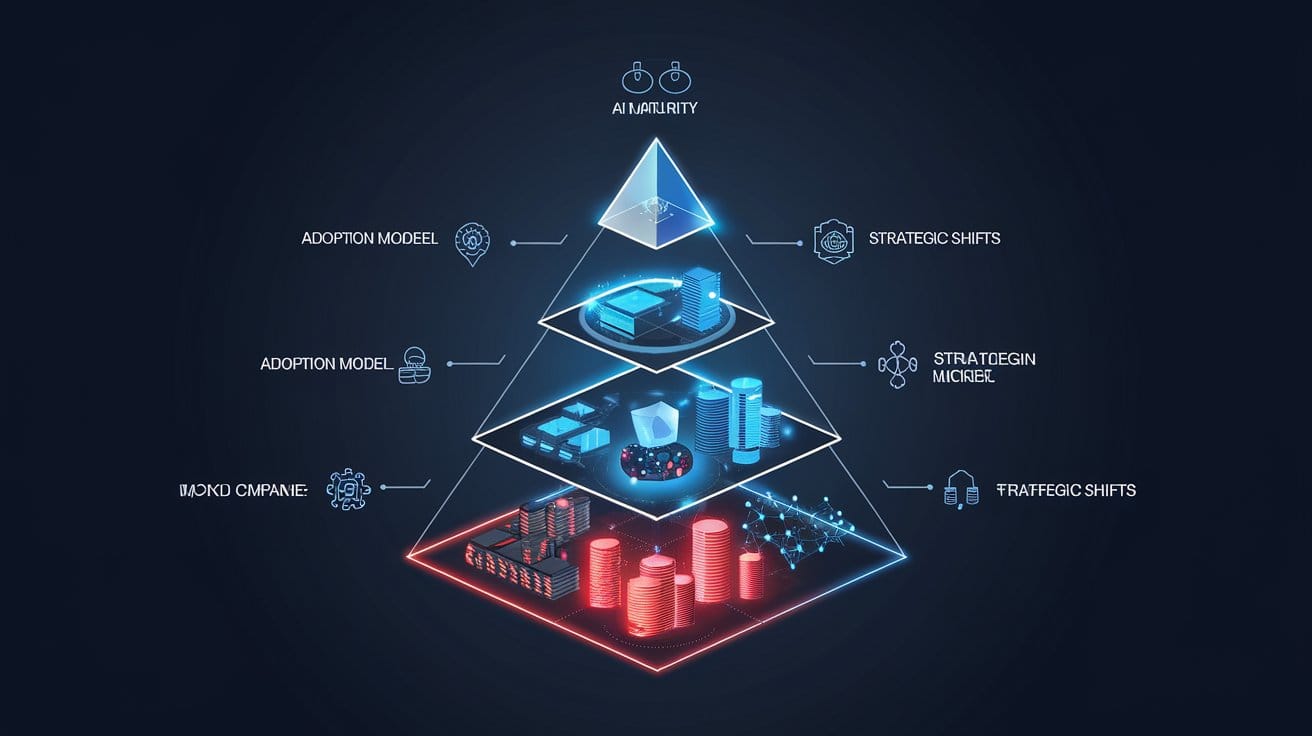
OpenAI's five AI value models—workforce fluency, process optimization, function enhancement, capability expansion, and business reinvention—sound like a maturity curve to climb sequentially. They're not. They represent three distinct business model transitions that require fundamentally different infrastructure, incentives, and organizational structures. Companies treating AI as a productivity multiplier are widening the gap with competitors who are rebuilding their economics from first principles.
Why the Five-Level Framework Misleads: It's Not a Ladder, It's Three Different Mountains
OpenAI's framework presents a clean progression: start with workforce fluency, move to process optimization, enhance functions, expand capabilities, and finally reinvent your business. The implicit message is that business reinvention comes after mastering the earlier stages. This is strategically misleading.
Companies that reach level 5 don't climb through levels 2-4. They skip directly to reinvention by treating AI as infrastructure, not tooling. The framework conflates deployment metrics—users, use cases, engagement rates—with strategic positioning. These are fundamentally different things.
Levels 1-2 (fluency and optimization) are about productivity. ROI gets measured in time saved per employee. You're making existing workflows faster. Every company will do this, which means every company will compress these gains to zero within 18 months. When your competitors have the same tools doing the same tasks, you haven't created advantage—you've maintained parity at higher speed.
Levels 3-4 (enhancement and expansion) are transitional states where most companies get stuck. They're trying to scale use cases across departments, treating each new application as incremental progress. But more chatbot deployments don't compound into business model change. They compound into a more efficient version of your existing business model, which competitors can copy instantly.
Level 5 is a different species entirely. Business reinvention changes unit economics, creates new revenue models, or eliminates cost structures. It's not "we use AI in more places"—it's "our business works differently now." OpenAI's equity stake in Thrive Holdings illustrates this pattern: they're not selling software licenses, they're embedding frontier research and engineering to rebuild how accounting and IT services get delivered. That's infrastructure-level transformation, not productivity tooling.
The real framework is three business models: AI as efficiency tool (levels 1-2), AI as capability extension (levels 3-4), and AI as economic foundation (level 5). Each requires different technical architecture, different organizational authority, and different success metrics.
The Level One Trap: Why Scaling Chatbot Access Doesn't Create Competitive Advantage
Most enterprise AI strategies optimize for breadth of adoption—seat count, engagement metrics, use case proliferation. OpenAI's enterprise data shows high adoption rates, but most use cases cluster around content generation, summarization, and research. These are commoditized tasks. When every company has ChatGPT Enterprise for proposal writing, nobody gained advantage—everyone just maintained parity at higher speed.
This creates a local maximum trap. Companies measure success by how many employees are using AI tools, not whether those tools are changing competitive position. The 'AI Center of Excellence' model optimizes for safe, incremental wins rather than business model risk. IT teams approve use cases that don't threaten existing workflows. Business units submit requests for "AI-powered" versions of existing tools. Nothing fundamental changes.
Consider consulting firms. Five years ago, writing proposals was a differentiated skill. Today, every firm uses AI for proposal generation. The task got faster, margins didn't improve—because clients expect faster turnarounds at the same price. The productivity gain accrued to customers, not firms. This is what happens when you optimize for efficiency without changing your value delivery model.
The data bears this out. According to OpenAI's 2025 enterprise report, companies are deploying widely but not deeply. Engagement metrics are up, but most organizations can't articulate how AI changed their unit economics. They measure hours saved, not business model shifts. This gap—between deployment breadth and strategic impact—is where competitive advantage dies.
The companies treating AI as a tool to make existing jobs faster are competing on a shrinking margin. The companies treating AI as infrastructure to eliminate job categories entirely are competing on fundamentally different economics.
The Three Business Model Transitions That Actually Matter
Reframe the five levels into three fundamental shifts. Transition 1: AI as cost reduction (levels 1-2). You're multiplying human output. Success metrics are hours saved per employee. This requires lightweight integration—API calls to gpt-4o, basic prompt engineering, minimal custom infrastructure. This is ChatGPT for everyone. Every company will do this. It creates no durable advantage.
Transition 2: AI as capability unlock (levels 3-4). You're doing things that weren't economically feasible before. Maybe you're personalizing customer interactions at scale, or analyzing data volumes that would require 10x more analysts. Success metrics shift to new offerings enabled, not just efficiency gains. This requires fine-tuning, custom evaluation frameworks, and deeper integration into product workflows. Some companies will do this well. It creates temporary advantage until competitors copy your approach.
Transition 3: AI as economic restructuring (level 5). You're changing the underlying cost structure or value delivery model of the business. OpenAI's partnership with Thrive Holdings demonstrates this pattern: they're not helping Thrive's accountants write better reports—they're rebuilding how accounting services get delivered, targeting 50%+ efficiency gains by embedding AI into core service delivery. Success metrics are new unit economics, not incremental improvements.
Here's the key insight: Transition 3 companies don't wait to master transitions 1 and 2. They architect differently from the start. They build custom infrastructure—fine-tuning pipelines, model evaluation frameworks, autonomous agent orchestration—while their competitors are still measuring ChatGPT seat utilization.
Example contrast: A bank using AI to write better investment memos is transition 1. A bank using AI to generate personalized investment products for every customer is transition 2. A bank using AI to eliminate the investment committee entirely by automating due diligence, risk assessment, and decision-making is transition 3. Same technology, different business model implications.
The companies that will win aren't the ones with the highest ChatGPT adoption rates. They're the ones rebuilding their cost structures while competitors optimize email workflows.
What Business Model Reinvention Actually Requires
Getting to level 5 isn't about scaling pilot programs. It requires different technical infrastructure, different talent, different governance, and critically, different executive incentives.
Technical requirements: You need fine-tuning infrastructure, not just API access. You need model evaluation pipelines that measure business outcomes, not just AI metrics. You need autonomous agent frameworks that can execute multi-step workflows without human intervention. Most companies are still doing basic prompt engineering through ChatGPT's interface. That's not infrastructure—that's tooling.
Organizational requirements: AI initiatives need product authority over core business processes, not IT support for existing workflows. This means business unit leaders rebuilding their P&Ls, not the CIO's office approving use cases. The Thrive Holdings deal structure reveals this pattern: OpenAI took an equity stake and embedded engineering directly into service delivery. They're not consultants recommending improvements—they're co-owners restructuring the business model.
Governance shift: Stop running AI ethics committees that approve use cases. Start empowering profit center owners to rebuild their economics. The current model—centralized AI governance reviewing requests from business units—optimizes for risk reduction, not competitive advantage. Business model reinvention requires accepting more risk in exchange for asymmetric upside.
Talent arbitrage: The best AI engineers don't want to optimize existing workflows. They want to rebuild industries. Companies stuck on transition 1 can't recruit top talent because the work isn't interesting. Companies pursuing transition 3 attract disproportionate talent because they're solving harder, more meaningful problems. This creates a compounding advantage.
Why current structures fail: AI initiatives typically report to the CIO or CTO—cost centers optimizing for risk reduction. Business model reinvention requires profit center owners with authority to make structural changes. When your AI team reports to IT, you'll get better IT processes. When it reports to the CEO and business unit leaders, you might rebuild your business.
The Compounding Gap: Why the Distance Will Accelerate
Companies stuck on transition 1 aren't just behind—they're falling further behind at an accelerating rate. Business model reinvention creates compounding advantages that productivity tools cannot match.
Data flywheel: Level 5 companies generate proprietary training data from their reinvented processes. Every transaction in their new model creates data that makes their AI better, which improves their unit economics, which attracts more customers, which generates more data. Companies using ChatGPT for email drafts generate no proprietary data. The gap widens with every cycle.
Talent concentration: The best engineers want to rebuild industries, not optimize email workflows. As the gap between leaders and laggards becomes visible, talent increasingly concentrates at reinvention companies. This accelerates their advantage—they're not just ahead on strategy, they're ahead on execution capacity.
Capital efficiency: Companies that change their unit economics can underprice competitors still operating on old cost structures. If your AI-powered business model delivers the same service at 40% lower cost, you can either take that as margin or use it to win market share through aggressive pricing. Either way, competitors stuck on transition 1 can't respond without rebuilding their own models.
Customer lock-in: New business models create different integration points and value delivery mechanisms. When you fundamentally change how your service works, switching costs increase. Competitors can't just copy your productivity tools—they need to rebuild their entire operational model to compete.
My prediction: By 2027, top-quartile AI adopters will show 40%+ margin advantages over median adopters. This won't come from productivity gains—it will come from fundamentally restructured unit economics. The current wave of "ChatGPT for everyone" deployments will look like the corporate blogging strategies of 2008: something every company did that created no lasting advantage.
The Skipping Strategy: How to Jump Directly to Business Model Reinvention
You don't need to master levels 1-4 before attempting level 5. Here's the concrete playbook for companies that want to leapfrog:
Start with one business unit. Don't try to transform the entire enterprise. Pick a unit with clear P&L authority, appetite for risk, and willingness to rebuild from first principles. Make the unit leader accountable for new economic outcomes, not adoption metrics.
Hire for reinvention, not optimization. Bring in people who've rebuilt business models—startup founders, product leaders who've launched new categories, engineers who've built infrastructure from scratch. Don't hire process improvement consultants. They'll optimize your existing model when you need to replace it.
Build custom infrastructure from day one. Set up fine-tuning pipelines, evaluation frameworks, and agent orchestration systems immediately. Don't graduate from ChatGPT—build differently from the start. If you're using the same tools as everyone else, you'll get the same results as everyone else.
Change the success metric. Stop measuring hours saved. Start measuring "new economic model validated" and "unit cost reduction achieved." If your KPIs are still engagement rates and use case counts, you're optimizing for the wrong outcome.
Example roadmap: Months 0-3, design the new business model and identify what needs to change structurally. Months 3-6, build technical foundation and recruit the right talent. Months 6-12, pilot the new model with real customers and real economics. Months 12-24, scale what works and expand to adjacent areas.
The key decision isn't "should we adopt AI?" Every company will. The decision is: would you rather be good at using AI tools by 2025, or have rebuilt your business model by 2027?
The companies that skip directly to reinvention won't have better productivity metrics in the short term. They'll have different businesses with different economics in the medium term. That's the gap that matters.
Key Takeaway: OpenAI's five AI adoption levels aren't sequential—they're three distinct business models. Companies optimizing for productivity (levels 1-2) will achieve table-stakes efficiency. Companies rebuilding their unit economics (level 5) will achieve structural competitive advantage. The winners won't be the ones with the highest ChatGPT adoption rates—they'll be the ones who skipped straight to different economics while competitors were still measuring hours saved.
Which AI Business Model Are You Building?
Discover if you're stuck at productivity gains or building true competitive advantage.